
Ngaru Whenua: Diffracting Indigenous Practices, Quantum Theory, Electronic Art and the Anthropocene
The pages here constitute the digital artefact associated with the exegesis. These are :
This page.
Documentation of the Interconnecting:pasha@patea Aotea Untanganui Patea Museum exhibition.
Arawhata Āniwaniwa Rainbow bridges
Documentation of the five year installation at Govett-Brewster Art Gallery Len Lye Centre.
Documentation of the etched kōhatu and jounrey to the sacred site of Taputapuātea, Ra’iātea
This digital archive is specific to the PhD.
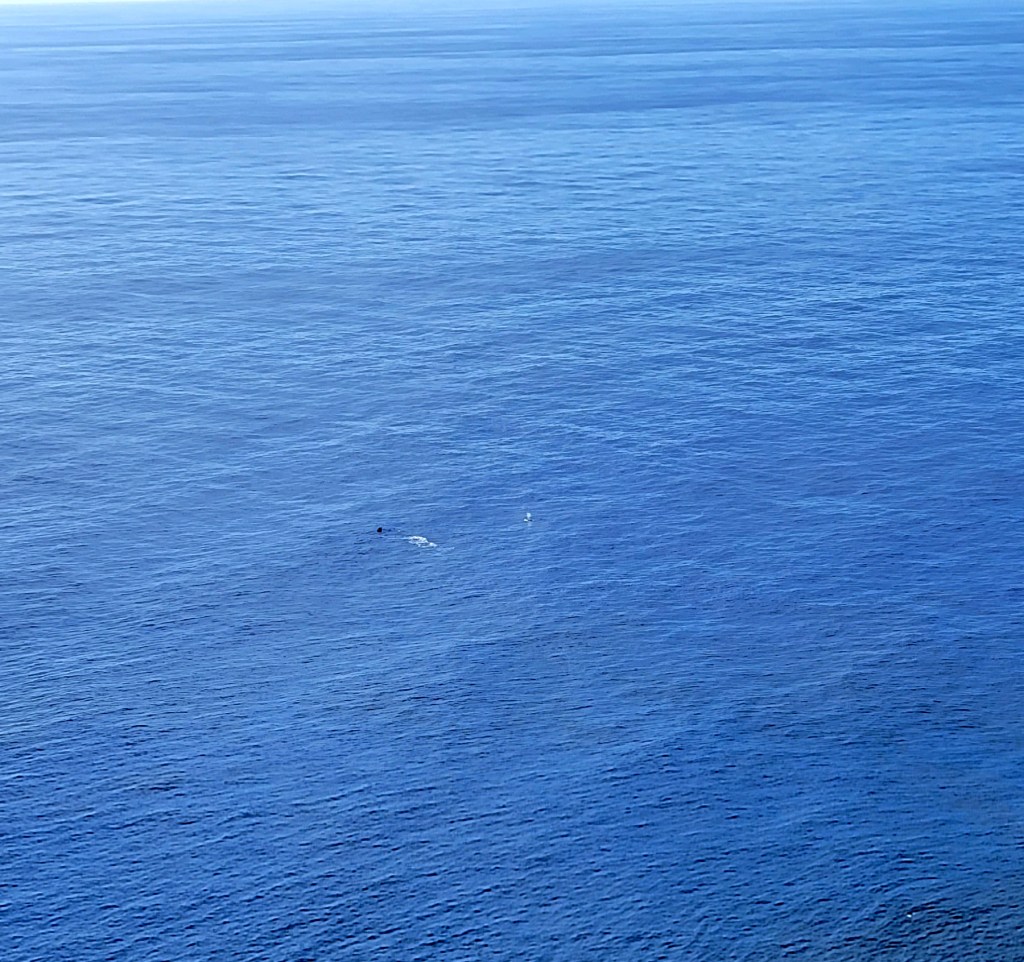
Ngaru Whenua wave forms off Hitiaurevareva Pitcairn. Note the way the wave forms stay distinct even when overlapping. The small white dots are a Humpack whale and calf.
Introduction
This is a practice-led PhD thesis by exegesis and digital artefact. The digital artefact component constitutes documentation of interconnecting: pasha@patea a one person and whanau (extended family) exhibition at Aotea Utanganui Patea Museum from the 17th of September to October 15th 2022; Kahili, a five year window commission at the Govett-Brewster Len Lye Centre blessed on Friday December 2nd 2022, one of the Arawhata Āniwaniwa (Rainbow Bridge) series; and Kōhatu Ra’iatea placed on Taputapuātea Marae, Ra’iatea on October 5th 2023. Documented here in a means specific to online review, are the creative outcomes from Ngaru Whenua diffractive practice.
I am proposing an evolution of the diffractive method initiated by Donna Haraway (1997) and extended into multi-disciplinary discussion by Karen Barad (2007). The evolution moves diffractive method into multi-cultural discussion. Based on traditional navigator awareness of wave patterning in the ocean, Ngaru Whenua Diffractive Method consists of citing full sentences of authors across cultural borders rather than paraphrasing; utilising a notion of knowledge as dimensional; citing precedence in Indigenous awareness; and considering the local and broader community. From within this warp and weft of energies, emerged the creative works solidly orientated in whakapapa (genealogy).
Abstract
Against a background of engaging with whakapapa (genealogy), the use of a creative wayfinding process, and concern regarding the Anthropocene, my creative practice has been completely renovated. A foundation of Indigenous Practices is laid down in traditional navigational practice, followed by a review of decolonising research methodologies and a discussion of knowledge as dimensional.
Ngaru Whenua wave patterns are known by traditional navigators and called diffractive in the West, and apply to light, water, and sound. In diffracting Indigenous Practices and Quantum Theory, the writing of Samoan authors on the Vā (Refiti, 2014) are diffracted against the writing of Barad (2007) with direct quotations used rather than paraphrasing. This protects the integrity of all authors’ words and the contention is that this is necessary when engaging in multi-cultural, multi-disciplinary discourse.
This approach is an essential core of Ngaru Whenua Diffractive Method. Alongside this is the necessity of acknowledging precedence (following Todd, 2016) in Indigenous awareness to the West, with particular reference to notions around the interconnected universe, which often go unacknowledged in Western literature. Cross referencing to the radiocarbon dating record (Wilmshurst et al, 2011) permits locating the epoch where important facets of Polynesian world view can be asserted with academic integrity.
Given the oceanic basis of the Ngaru Whenua discussion, the author’s oceanic whakapapa and the consequences for creative practice are outlined, introducing the key theme of wayfinding as creative practice. Resolving to a personal level the issues of whakapapa and Polynesian diaspora provides important guides to the development of a visual vocabulary. The vocabulary is taken into diverse media and contexts both within and beyond the art and cultural sector, exemplified in wayfinding journeys of research and practice. Consequences for creative practice are further reflected on in a diffraction of Electronic Art and the Anthropocene.
Laser etching on Kōhatu for sacred navigator sites culminated in the permanent placement of an etched Kōhatu on Taputapuātea Marae Ra’iātea. This was supplemented by a curated one person and extended family exhibition at Aotea Utanganui Patea Museum exploring the critical Polynesian notion of an interconnected universe, and a five year window commission for the Govett-Brewster Art Gallery Len Lye Centre, which sits among the creation of digital imagery. These constitute the practice led orientations propelling the project forward in a universal ocean of whakapapa, a relational space of reciprocity where the subject-object distinction is no longer fundamental.
References
Barad, K M. (2007). Meeting the Universe Halfway: Quantum Physics and the Entanglement of Matter and Meaning. Duke University Press.
Haraway, D. (1997). Second millennium FemaleMan© meets OncoMouseTM: Feminism and technoscience. Routledge.
Refiti, A. (2014). Mavae and Tofiga: Spatial Exposition of the Samoan Cosmogony and Architecture. PhD Thesis AUT, Auckland.
Smith, L. (2012). Decolonizing Methodologies. Dunedin: Otago University Press.
Todd, Z. (2016). An Indigenous Feminist’s Take on the Ontological Turn: ‘Ontology’ Is Just Another Word For Colonialism. In Journal of Historical Sociology Vol. 29 No. 1. DOI: 10.1111/johs.12124
Wilmshurst, J. Hunt, B. Lipo C. and Anderson, A. (2011). High-precision radiocarbon dating shows recent and rapid initial human colonization of East Polynesia. In Proceedings of the National Academy of Sciences February 1, 2011 vol. 108, no. 5, p 1815–1820.
 The website of Mahutoa 'Pasha' Clothier