
Overview – Diffracting Indigenous Practices, Quantum Theory, Electronic Art and the Anthropocene
Pasha Ian Clothier
VC Scholarship
AUT
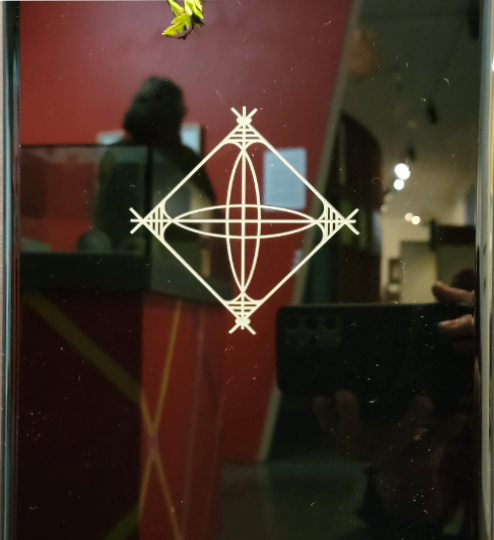
The laser etched pattern on this molded acrylic form is based on a diagram by Spenneman (1998) of a Marshall Island stick chart that is used to teach about currents around islands. Photo credit: Pasha Clothier CC4.0 BY-NC-ND
Important contributions of the project: acknowledging Indigenous precedence; cross referencing Moana peoples (Polynesian) oral heritage and cosmology with radiocarbon dating evidence and the DNA record; diffracting from one culture to another – using a decolonised notion of knowledge as dimensional, and maintaining the mana or integrity of authors words by using block quotes rather than paraphrasing.
This project brings together the diverse contexts of Indigenous Practices, Quantum Theory, Electronic Art and the Anthropocene, to provide a decolonised approach contributing to resolving human-forced climate change issues. Three important contributions are made, the first of which is (following Zoe Todd, 2016), a statement of intent to cite Indigenous Practices (Wilson, 2008; Wilson-Hokowhitu 2019; Reynolds & Wheeler, 2022) first wherever reasonable ground for precedence to the West can be located. This is strictly followed.
The second contribution is to cross-reference Polynesian philosophy with DNA (Ionnadis et al, 2020) and radiocarbon dating records (Wilmshurst, Hunt, Lipo & Anderson, 2011), to provide a precise timing of when aspects of Māori and Moana world view were in place. As such 1190-1290CE – the period of the settlement of Eastern Polynesia provides a firm date for when the notion of Interconnection (Waikerepuru, 2011) was with Moana peoples. This is seven hundred and ninety years before similar concepts entered Western academic discourse (Deleuze & Guattari, 1987; O’Sullivan, 2001).
The third contribution is to provide a basis for bringing Indigenous Practices into dialogue with Western Science outside of a Western knowledge framework, applying a diffractive method to intercultural dialogue, and basing a discussion of Indigenous Practices on a notion of knowledge as dimensional. This enables the unlocking of Indigenous Practices in a way the Practices unfold for the reader, without necessarily requiring the dissemination of sacred knowledge itself. Following Smith (2012), Colonial bias in Western academic method is acknowledged, before using a Ngaru Whenua diffractive method to diffract the Samoan concept of Vā and Quantum Theory. Ngaru Whenua method maintains the mana of Samoan voices (Wendt, 1996; Refiti, 2014; Lopesi, 2021)and Barad (2007) on Quantum Theory, by using block quotes and directly aligning text using quotations rather than author composed summaries.
This forms background to diffracting Electronic Art and the Anthropocene, leading back to Moana cosmology for important pointers. In pursuing a trajectory of creative wayfinding based on the contexts given above, extraordinary results were attained. The creative project culminated in the placement of an etch Kohatu on Taputapuatea Marae, Ra’iatea.
The peak experience in the project was to work with Tohunga (Priest) Tihoti leading to the permanent placement of a light etched Kōhatu on Taputapuātea Marae, Ra’iatea – a great honour doubled by being taken to the place were Kōhatu were selected, in order to bring one back to Aotearoa New Zealand. The photo above shows a view of the Marae, which has eight marae on one site, all with their own purpose in pre-Colonial times. Photo credit: Pasha Clothier CC4.0 BY-NC-ND

A view of part of the installation Interconnecting: pasha @ patea showing the pou (post) in foreground bearing imagery related to tupuna (ancestors). Engaging with tupuna became one of the most significant trajectories of the PhD. Above at left is a Georgian writing bureau contemporary with the Mutiny on the Bounty saga 1790; on the wall are tupuna images dating to 1830; my grandmother, and my parents wedding photo of 1948. The cabinet at right contains artefacts made by whanau (extended family) on Hitiaurevareva – the island on which the Tahitians and sailors on HMAV Bounty made their settlement.
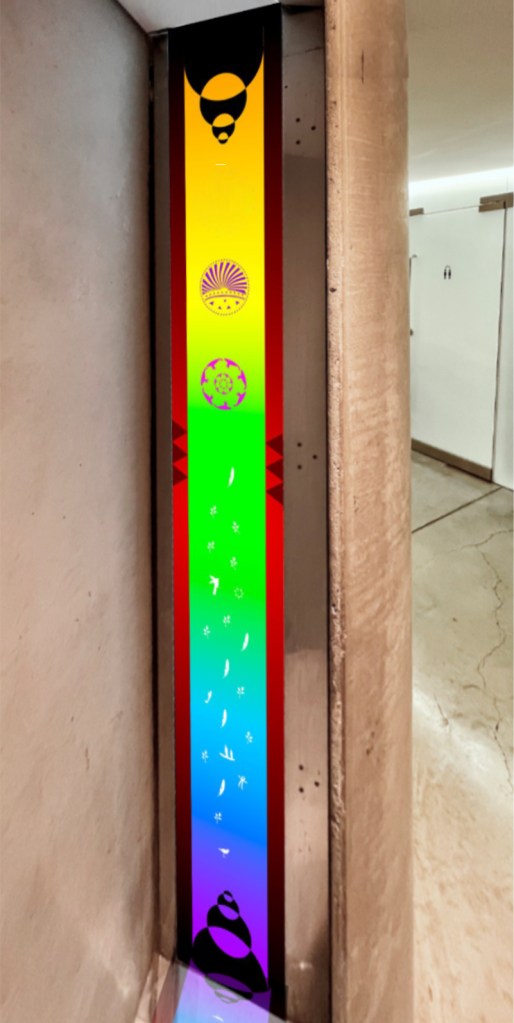
Kāhili
This work is one of the Rainbow Bridge series, which are intended as bridges from Indigenous – in this case Moana or Polynesian peoples to whom I belong – to the West. The notion of doing this was prompted by my Kumu (Teacher) Kawaihululani who is a guide, friend and mentor.
Some of the imagery relates to my whakapapa (genealogy) and directly refers to tupuna (ancestors). Therefore, the window was blessed with appropriate processes. It was very synchornistic that the window blessing event coincided with Te Ua a major exhibtion of Moana and Māori artists contextualised around water.
There is imagery going all the way up and down the work, which deliberately places visuals within the sight line of children. Considering the generations is typical in Moana and Māori culture.
Shannon Novak made the arrangements for the five year install of this clear vinyl work through which the light shines. Light and rainbows are important components to Hawai’ian cosmology, a reflection of the input of Kawaihululani.
References
Deleuze, G. & Guattari, F. (1987). A Thousand Plateaus. Minneapolis: University of Minnesota Press.
Ioannidis, A.G., Blanco-Portillo, J., Sandoval, K. et al. Native American gene flow into Polynesia predating Easter Island settlement. In Nature 583, 572–577 (2020). https://doi.org/10.1038/s41586-020-2487-2
O’sullivan, S. (2001). The Aesthetics of Affect in Thinking Art Beyond Representation. ISSN 0969-725X print/ISSN 1469-2899 online/01/030125-11 Taylor & Francis Ltd and the Editors of Angelaki. DOI: 10.1080/09697250120087987
Reynolds, P., & Wheeler, V. (2022). Mā’ohi methodologies and frameworks for conducting research in Mā’ohi Nui. AlterNative: An International Journal of Indigenous Peoples. Vol 18 (4), 488–495. https://doi.org/10.1177/11771801221114999
Spennemann, Dirk H.R. (1998). Essays on the Marshallese Past Second edition. Albury: Charles Sturt University. http://marshall.csu.edu.au/Marshalls/html/essays/es-tmc-2.html
Todd, Z. (2016). An Indigenous Feminist’s Take on the Ontological Turn: ‘Ontology’ Is Just Another Word For Colonialism. In Journal of Historical Sociology Vol. 29 No. 1. DOI: 10.1111/johs.12124
Waikerepuru, H. (2011). Te Hihiri o Te Taiao. http://www.intercreate.org/huirangi-waikerepuru/
Wilmshurst, J. Hunt, B. Lipo C. and Anderson, A. (2011). High-precision radiocarbon dating shows recent and rapid initial human colonization of East Polynesia. In Proceedings of the National Academy of Sciences February 1, 2011 vol. 108, no. 5, p 1815–1820.
Wilson, S. (2008). Research is Ceremony: Indigenous Research Methods. Black Point:Fernwood Publishing.
Wilson-Hokowhitu, N. (2019). The Past before Us: Moʻokūʻauhau as Methodology. [ED.]. Honolulu: University of Hawai’i Press.
 The website of Mahutoa 'Pasha' Clothier