
Kāhili
Kāhili is a work in the Arawhata Āniwaniwa Rainbow Bridge series. These are intended to bridge Moana culture to Western culture without recourse to logic and rationality, and be accessible by all ages and genders – this was prompted by Kawaihululani. Developing the intuitive resource is important to nourishing the human connection to environment, as clearly rational statistics are insufficent to being about substantive change.
Discussion of rainbows led to an investigative period with prisms and revisting previous works exploring light. There is a sense of Rainbow that intersects identity. So there is a tripartite meaning here: from visible light to identity to intuition.
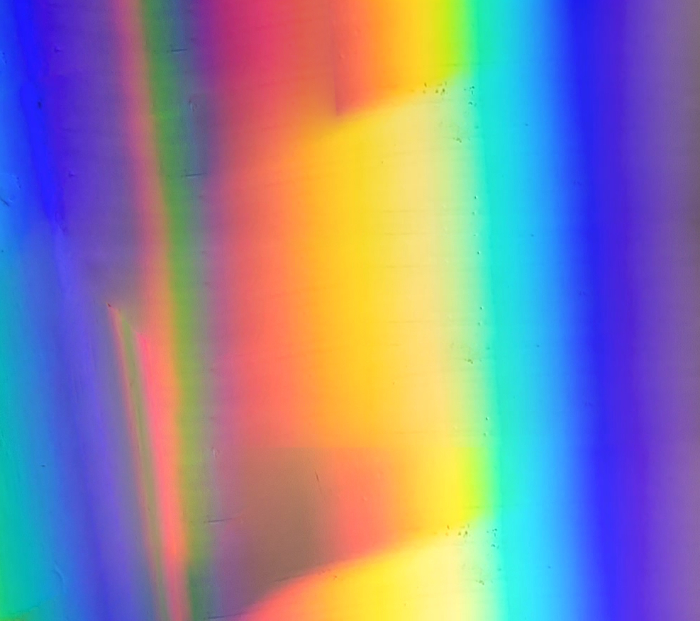
This is a texture made of multiple prism experiments. The spectra above are generated by cut glass prisms. One form the prisms, acrylic with three wide faces can encompass the filed of vision and used in the Family Art workshops at the Govett Brewster.
Figure 128
Kāhili, 2022
Digital print on transparent vinyl

Note. The transparency of the media is revealed in the vertical line running behind the image, made by the building superstructure. The curved exterior of the Govett-Brewster-Len Lye Centre can be seen in the curved line between the Golden Plover and the Hitiaurevareva rose form. While this media has limited capacity for recycling (requiring sending overseas), the five year period of the commission is regarded as a mitigating factor in using the product. While any method using transportation and computers is entangled in resource complexity, I no longer make extensvie use of this media and today seek a balance between computing and nature. Photo by the artist-writer.
Arawhata Āniwaniwa Rainbow Bridges
Figure 129
Arawhata Āniwaniwa A, 2023
Digital image

Note. The triangles are a reference to tiputa (poncho style garment) made on Hitiaurevaeva (Pitcairn Island) around the key period between 1800 and the 1830’s, when according to my research, there were very strong Tahitian influences on the culture: Tahitian style va’a were used, the tiputa was worn, each house had a bakehouse and a place for making ahu (tapa), and paafata (pataka) were used for food storage. Thanks to the research of Pauline Reynolds, there was a stylisitc and structural innovation made by the vahine (women) in the form of an additional band over the shoulders, decorated with rows of triangles. This innovation identifies the tiputa as coming form Hitiaurevareva.
Figure 130
Arawhata Āniwaniwa B, 2023
Digital image

Note. In the green band there is an image to the right of centre that looks like a kite perhaps. This is a Magel or Marshall Islands stick chart, which were used to teach about currents around islands and not taken on board. I think of the paired whiote lines as the tracks of va’a horua the twin hulled waka or canoe, which is also a symbol of my māhū identity.
 The website of Mahutoa 'Pasha' Clothier