
This page contains charts or tables from recent research.
Regarding decolonisation, the first thing that has to happen is that intuition around the significance of Indigenous knowledge needs to be improved in the West. The Western mindset needs data – information – to provide a basis for building intuition and knowledge of a subject. This is what this page is about.

This image was created following the journey to Ra’iatea. It is based on a ‘star commpass’ and has 32 triangles – there are 32 houses in some traditional Kaiwhakatere Navigator star compasses.
The first chart given here documents population losses following colonisation, which is a driver to decolonise.
The similarities of language among people of the islands of Te Moana Nui a Kiwa Pacific Ocean indicate shared cosmology and beliefs in the second chart.
There is radiocarbon dating evidence for the rapid settlement of eastern Polynesia – therefore deliberate voyaging leading to permanent settlement, occurring between 1190CE and 1290CE. There is also the evidence and summary chart of DNA intermixing between Moana peoples and South Americans, commencing in 1150CE – which also confirms deliberate, extensive voyaging.
When the above is taken together, we have a strong case for asserting the idea of interconnection, a core part of beliefs systems across Eastern Polynesia, was with Polynesians by 1190CE. This is around 790 years before similar ideas were discussed in the West. Consequently, the second part of decolonisation is to acknowledge precedence and in so doing, build respect for Indigenous knowledge.

The chart above is the impetus behind the need to decolonise Western academia and where possible, Western society. These statistics reveal the devastating impact of European colonisation on the Indigenous Peoples of Te Moana Nui a Kiwa (Pacific Ocean)1.
1. It is acknowledged that Rapa Nui also suffered from colonisation by Peruvians.
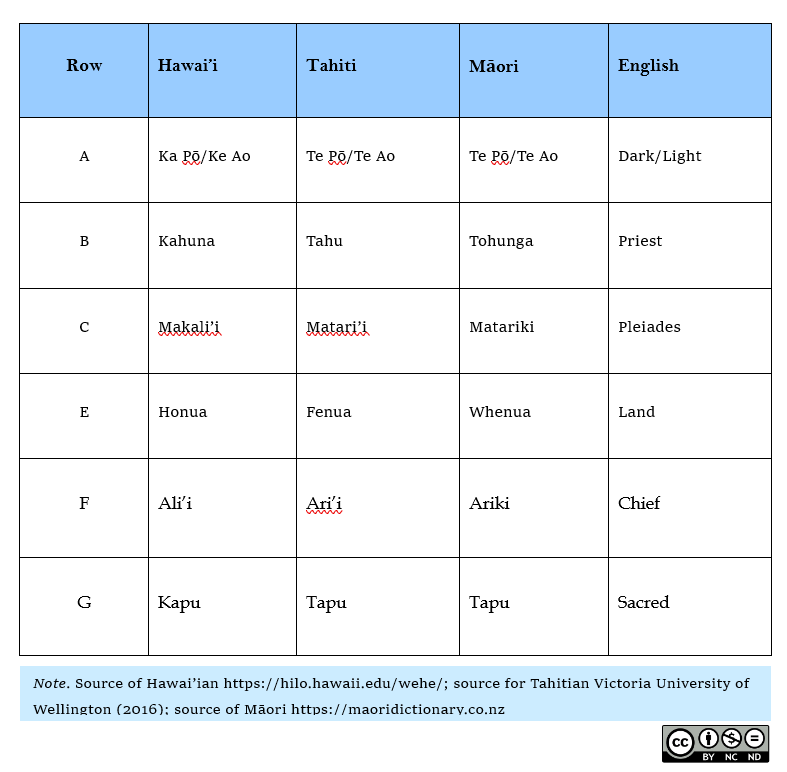
From this chart we can see that there is a striking similarity in the languages of people across Te Moana Nui a Kiwa – from Hawai’i to Aotearoa New Zealand in the south and Tahiti in between.
The point of this is to establish cultural and cosmological similarities in Moana and Māori peoples. The terms for sacred, dark/light and Priest reveal very strong similarities. That is important to establish because among these cultures the notion of an interconnected universe is common.
Evidence via the radiocarbon dating record (Wilmshurst, Hunt, Lipo & Anderson, 2011 – see chart below) reveals that there was a rapid period of settlement of the region of Eastern Polynesia (Hawai’i to the north, Aotearoa to the south and Rapa Nui to the east) between 1190 and 1290CE. This is the start of permanent settlement, and it is clear that language and cosmology travelled with the peoples.
Consequently, there is a very strong basis for saying the idea the universe is interconected has been with Polynesians since 1190CE, which is 790 years prior to similar notions being discussed in the West, particularly by Deleuze and Guattari in 1987. These two French philosophers who are widely quoted in many disciplines in Western universities including Philosophy (Callinicos, 1985), History (Bell & Colebrook, 2009), Science (Bazzul & Kayumova, 2016), Art History (van Tuinen & Zepke, 2017) and the post-Colonial discussion (Huggan, 1989).
The time has come for this acknowledgment to be spread across society and in academia wherever ideas around interconnection are discussed. This is a simple matter of acknowledging precedents.
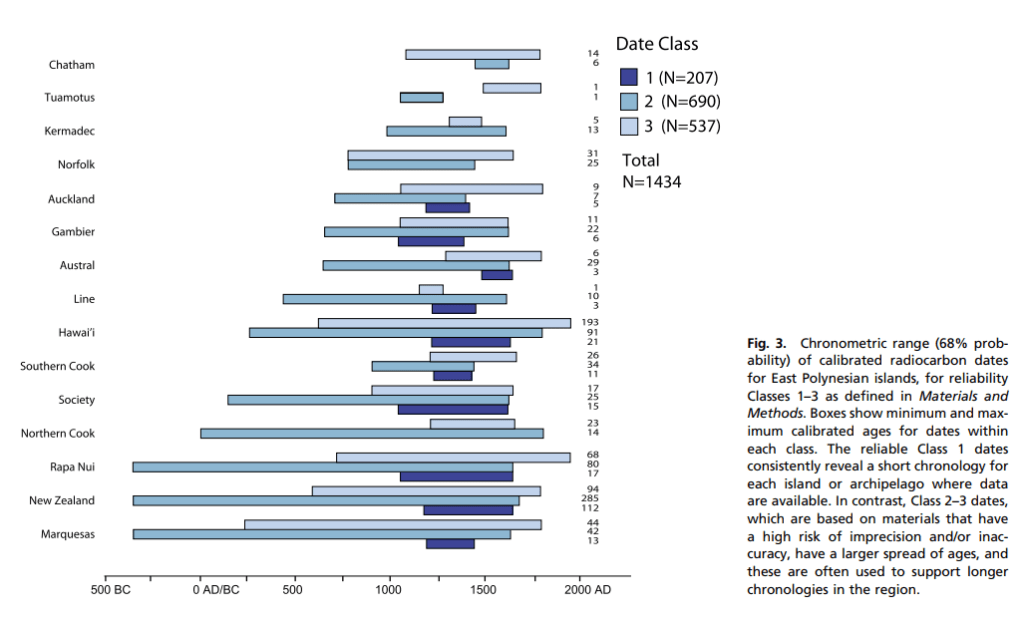
The important part of this chart lies in the dark blue coloured areas. These are Class 1 sample dates, the most certain of all categories of radiocarbon dating. This is the basis for Wilmshurst et al (2011) giving the period 1190 – 1290CE as the period of rapid settlement.
Of note is the long tail of Class 3 (middle blue colour) sample. While having a wide standard deviation (i.e. dating is in a wide range rather than specific) these go back around 300BCE in the Marquesas, Aotearoa New Zealand and Rapa Nui. This means that within around century of this date, someone was lighting fires and eating food at this early time. In my view, this is evidence of early exploration of Te Moana Nui a Kiwa Pacific Ocean.

What we have here are the dates where there is DNA evidence of intermixing between Moana Polynesian peoples and South Americans. This means that there was contact to the point of raising generations and look at those dates – South Marquesas and Guatemala 1150CE. Colombia features in two periods. All dates except Rapa Nui fall within the period of rapid settlement as given by Wilmshurst et al (2011).
The chart given below by Ioannidis, Blanco-Portillo, Sandoval et al (2020) follows below. This is the work of 31 academics across several fields of academia including DNA researchers, Anthropologists and Archeologists.
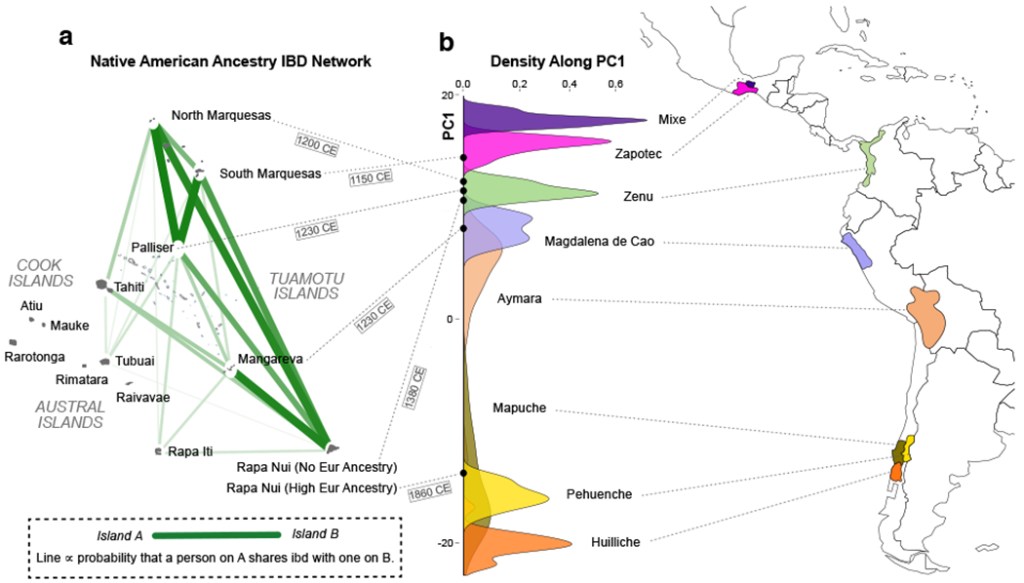
Native American gene flow into Polynesia predating Easter Island settlement by Ionnadis et al (2020). While there is discusion in the West regarding whether moana peoples went east or South Americans went west, there is ample evidence of voyaging in Polynesia to assert Moana peoples went east. There are Western academics who cite the voyage of Thor Hyerdahl however as Crowe (2018) put it, Hyerdahl drifted to the Tuamotus and was no closer to Rapa Nui than when he set out. The currents near to South America are particularly strong, and require significant skill to navigate, something that has been with Moana peoples since 950CE, which is evidenced by radiocarbon dating.
From all the above, we can now assume that Polynesians were explorers. The exploration of Te Moana Nui a Kiwa Pacific Ocean began in early days; that by 1190CE most of Te Moana was known and that settlement had begun at the same time as intermixing occured with South Amerian nations. They travelled on highly sophisticated ocean craft using highly sophisticated skills, navigating without instruments. The idea of an interconnected universe was extremely useful to them.
Well that’s it for the moment – the path to decolonising society and academia is outlined through the work of many, not least the Kaiwhakatere Navigators, the whanau families that resulted from the interaction of cultures, and artists, scientists, anthropologists and archeologists.
 The website of Mahutoa 'Pasha' Clothier