
The first two blogposts looked at navigation in the period 300-100BCE, and oral traditions on Fiji and among Māori. This has given a picture of voyaging across the vast expanse of Te Moana Nui around two thousand years ago.
It is now time to look toward the petroglyphs themselves, and to attain a focus we shall first look at other sites, on Hawai’i and throughout the Society Islands, to see how this might inform what is Down Rope. This post comes in two parts, the first looking at sites across Te Moana Nui, the second looking at those Down Rope.
Hawai’ian and Society Islands Petroglyphs
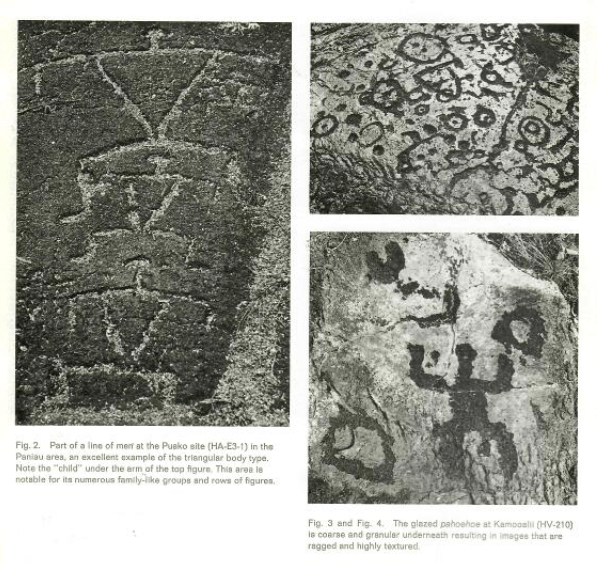
J Halley Cox and Edward Stasack wrote Hawaiian Petroglyphs published by the Bishop Museum in Hawai’i in 1970, which is the source of the photographs above. You can see in the upper right photograph that there are a lot of circular indentations. It has been speculated that these circles which are common to petroglyph sites, may refer to full moons, but this hasn’t been conclusively confirmed. It is also common to see concentric circles, circles within circles.
To the left above, we can clearly see what are called ‘the triangular men’ forms which are also found through Te Moana Nui. At lower right, the images are clearly ‘filled in.’
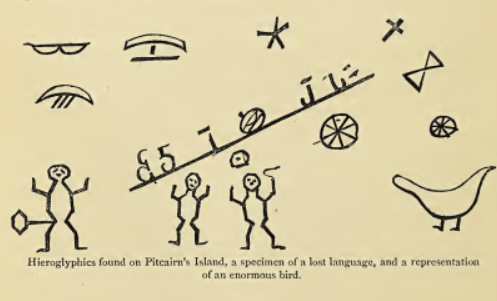
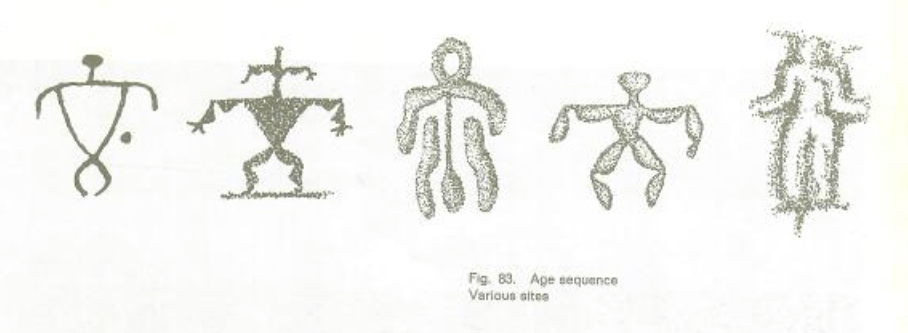
This filling-in of imagery can provide a rough guide to the age of the glyphs. You can see from the image below (from p 61 of Hawaiian Petroglyphs) that initially the imagery was linear, which became filled in and on the far right the surface of the surrounding rock has been removed so the figure is raised. While there is no timeline attached to this sequence, and the image development is assumed, one takeaway from the image is that the Pitcairn petroglyphs come from the early period.
In a recent chapter (2020) on Polynesian petroglyphs, Sidsel Millerstrom and Heidy Baumgartner-Lesage made a survey of Society Islands petroglyph sites, extending from Bora Bora through Ra’iātea, Huahine, Mo’orea and Tahiti to the Marquesas. They remarked on the continuity among islands of Eastern Polynesia:
“Many of the same images seen in petroglyphs are found in tattoos and material objects. This suggests that the fundamental principles regarding the symbolic order remained relatively unchanged until the historic period. The same situation occurs in other Polynesian islands or island groups, as for instance, in the Marquesas Islands, Hawai’i, and Rapa Nui (Easter Island).” This means that across the islands of Te Moana Nui, there appears to be a consistency to petroglyphs in the early period, associated with linear petroglyphs.
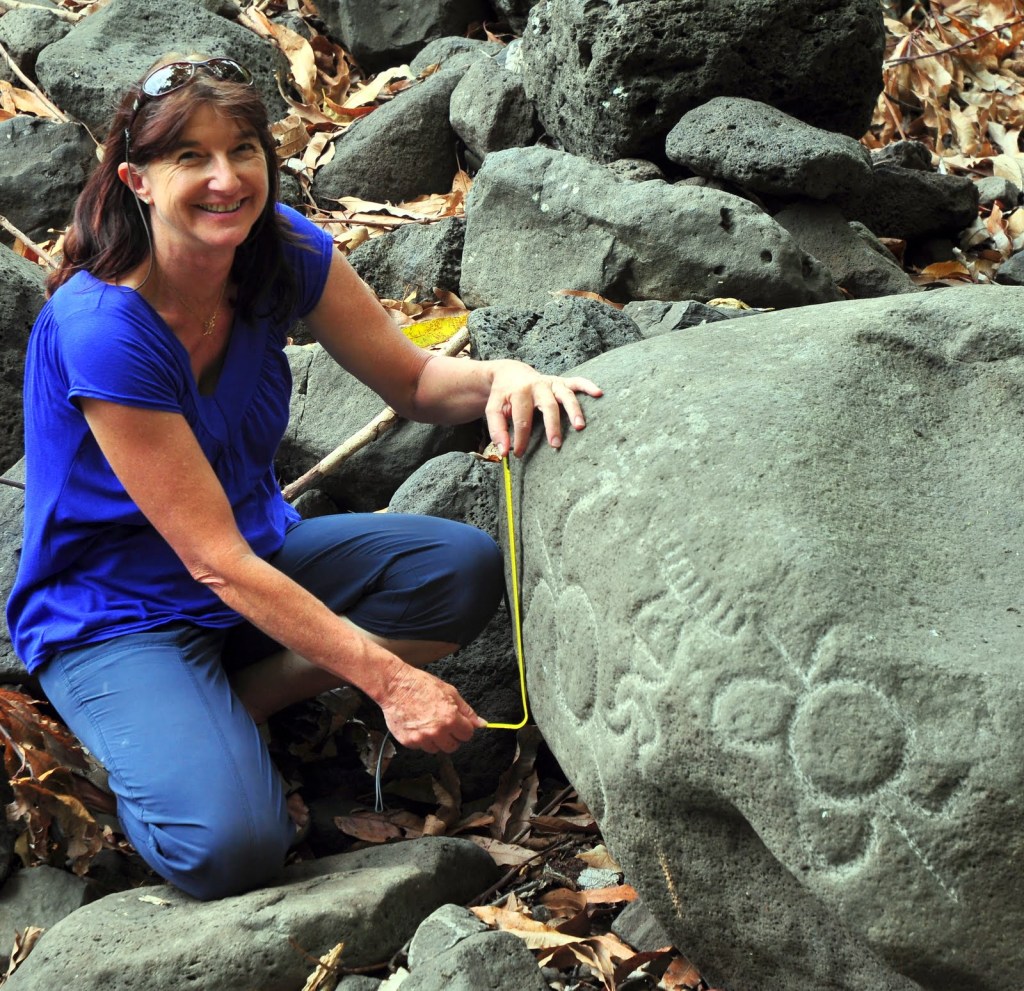
The authors went on to say: “The images of the Society Islands are culturally and stylistically linked to those of Eastern Polynesia, especially the petroglyphs of the Marquesas and in large part those of the Hawaiian Islands.” To give an idea of what many Eastern Polynesian petroglyphs look like
Millerstrom and Baumgartner-Lesage also produced the table below, documenting the number and types of imagery. It is useful to consider commonalities, and ask what categories might be shared.
The relationship between image types and percentages on the Leeward Islands of Huahine, Ra’iatea, and Bora Bora
| Image types | Islands, number of petroglyphs and percentage | Total numbers of images and percentage | ||
| Huahine | Ra’iatea | Bora Bora | ||
| Anthropom-orph | 0/0 | 15/6.9 | 0/0 | 15/5.2 |
| Turtle | 11/36.7 | 117/53.9 | 32/78.1 | 160/55.6 |
| Fish | 0/0 | 4/1,8 | 0/0 | 4/1,4 |
| Canoe | 3/10.0 | 6/2.8 | 0/0 | 9/3.1 |
| Headdress | 0/0 | 1/0.5 | 2/4.9 | 3/1.0 |
| Geometric | 14/46.7 | 74/34.1 | 6/14.6 | 94/32.6 |
| Unidentified | 2/6.7 | 0/0 | 1/2.4 | 3/1.0 |
| Total | 30/100 | 217/100 | 41/100 | 288/100 |
Using the categories above, the petroglyphs Down Rope have anthropomorphic, geometric and undefined forms. The categories of turtle, fish, canoe and headdress are absent. There is a single compass rose on Tahiti, and twelve funerary mask petroglyphs, categories not seen on Pitcairn. As in the Hawai’ian photos above, the images predominantly are on boulders.
The geometric figures referred to constitute the largest image category, with 48% overall (both Leeward and Windward Islands), the next highest grouping is turtles at 33.5%, then anthropomorphic at 11%. There aren’t any turtles Down Rope, and to give you more of an idea of what geometric and anthropogenic figures look like, here are two drawings, which can’t be shared or forwarded as I am waiting on copyright clearance.
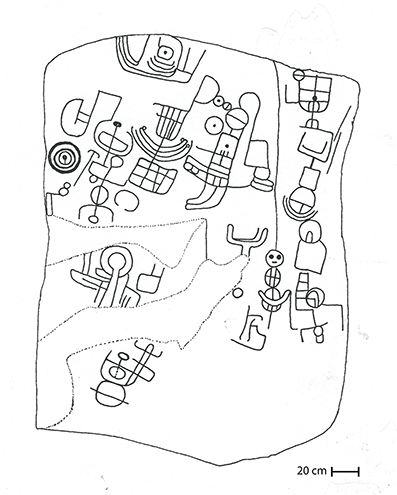
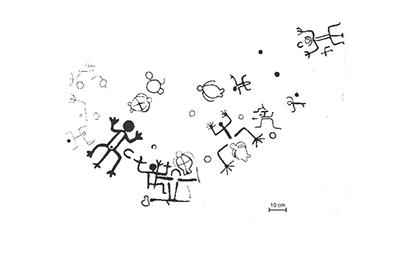
The geometric forms of the image by Edwards in 1988 bear little resemblance to those Down Rope. While the figures of the 1989 image have upraised arms, they also have the distinctive splayed fingers seen at other sites (see the second left drawing of the ‘age sequence’ image above). Splayed fingers and toes are not evident in the figures on Pitcairn.
There is one more aspect we need to review before going Down Rope. That is, many sites of petroglyphs reveal that not all were added at the same time. Some of the Hawai’ian sites have imagery such as sailing ships, horse and rider, and goats added to boulders where much older petroglyphs are evident.
Conclusion
While the petroglyphs Down Rope contains imagery that can be categorised as anthropomorphic and geometric, missing categories that are distinctly Moana includes turtles, fish, canoe and headdress. The petroglyphs on Hitiaurevareva are not on boulders and not associated with marae sites or banyan trees, unlike many across the Society Islands and Tahiti. It is time now to gather the information from the first three blogs and see if it is possible to provide insights leading to an interpretation.
 The website of Mahutoa 'Pasha' Clothier