
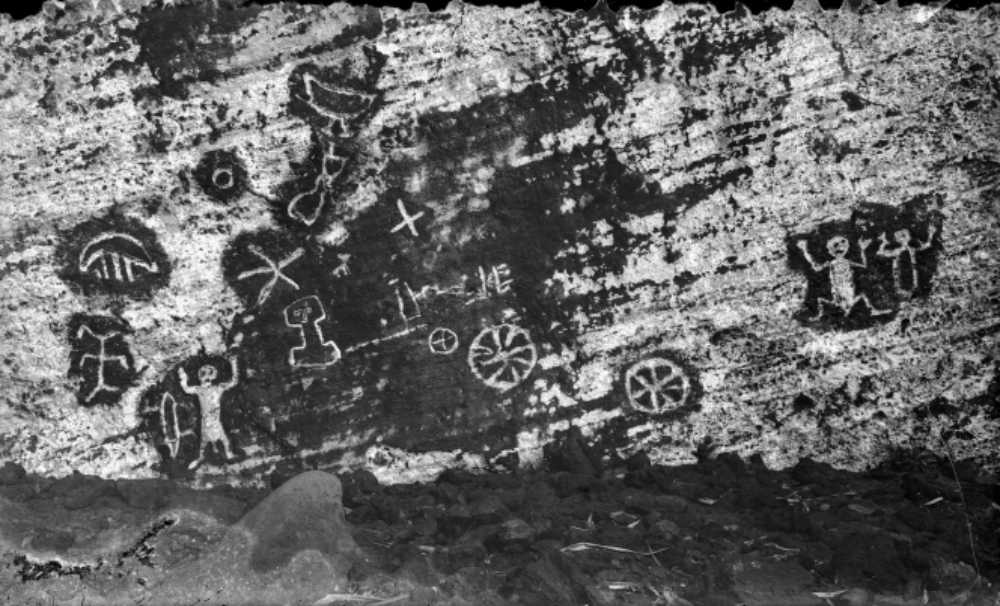
This is the second of a series of posts on the Pitcairn (Hitiaurevareva) petroglyphs. The first blogpost looked at where navigation was in the period 300-100BCE. What was found was that someone was sailing around and lighting fires in Aotearoa New Zealand, the Marquesas and Rapanui around this time, based on radiocarbon dated evidence. This could have been Polynesian or Moana peoples. At the same time, the knowledge of the layout of Earth, with a north and south pole, tropics and an equator was known to Egyptians at this time.
This second blog looks at oral traditions among Māori and on Fiji. Surprisingly, a highly respected Kaumatua in Aotearoa – Dr Te Huirangi Eruera Waikerepuru – claimed clearly and often that there was an early connection between Māori and Egypt, and we saw in the first blog that the region of the north of Africa was one wide area, inhabited by Berber groups. Consequently, some refer to this area as Egypt, and some Libya, but in the days before distinct national borders, country designations were imprecise.
The next part looks into some highly specific and detailed information contained in oral traditions on Fiji. Readers have to make their mind up about the veracity of oral heritage, but more and more is being confirmed today, as scientists and archaeologists look beyond preconceptions. The oral tradition that Polynesians reached South America is now confirmed by DNA data, for example. As for me, I now treat oral tradition as primary, and try and locate Western evidence as secondary source confirmation – an approach that has proved fruitful.
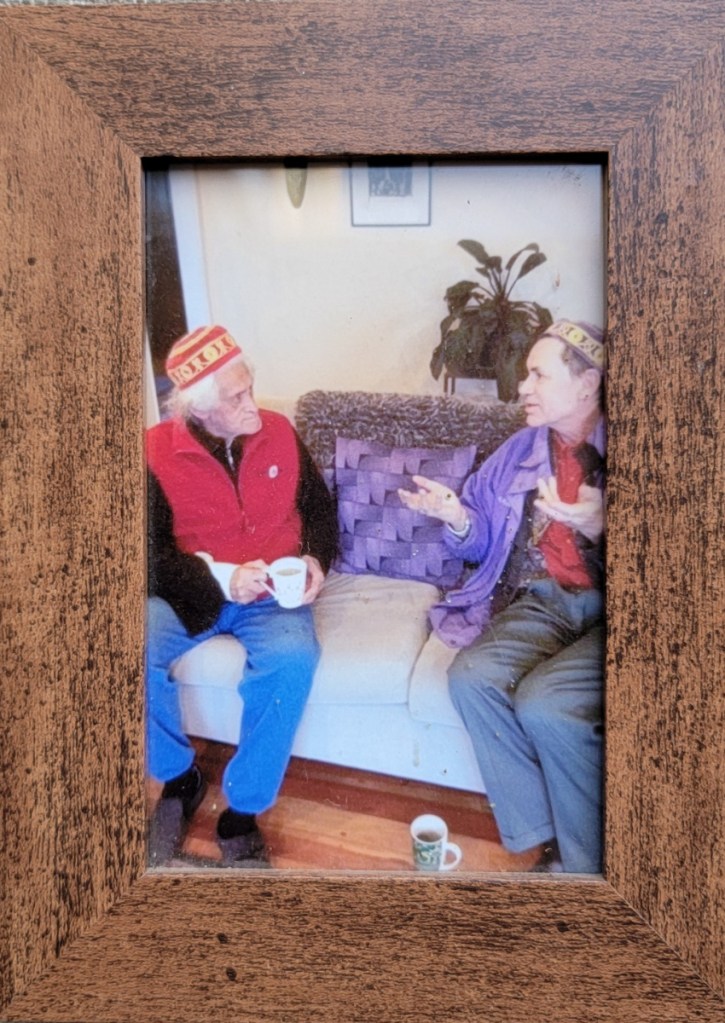
Dr Te Huirangi Eruera Waikerepuru
This is a photo of me and Huirangi having one of many conversations on the couch. We worked alongside each other for a period of ten years, involving multiple projects in Taranaki, and exhibitions in Istanbul, Albuquerque and Rio de Janeiro. Huirangi was recognised for his special abilities as a child and sent to live with older generations who brought him up with traditional, pre-Colonial knowledge. He later championed Māori being legally acknowledged as an official language of Aotearoa, and became acknowledged world-wide for his leadership and support of Indigenous issues.
He always maintained there was a link between early Māori and Egypt. For example, he always said “Rangi is not Rangi, it is Ra-ngi, a reference to Ra, the Egyptian sun god.” He would point out that ‘Mauri ora’ which is a common ending to karakia or prayers, and means several things including vital health or life esseance, can also be said “Ma uri o Ra” which means ‘we are the descendants of Ra.’ Unfortunately I didn’t really interrogate this much with him, but accepted that this was a piece of traditional, pre-Colonial Māori heritage.
One aspect of this connection Huirangi spoke of is that there are Māori who have DNA from the region we are discussing. One is Sir Jerry Mateparae, former Governor General and another is a personal friend who prefers to keep this confidential. Between them they have had ten children who will of course also carry this DNA. The problem here is that the pdf slide has the heading ‘1000 to 100,000 years ago” which is a bit broad, so I’m trying to locate the information for more precise timing. Huirangi wasn’t alone is asserting the connection, let’s now look at Fijian oral tradition.
Fijian oral tradition
On Fiji, there is an entire heritage among Chiefs of Vuda, based on an historical figure Lutunasobasoba. In the late 1970’s, the Chiefs told the story to an artist and writer Kristin Zambucka. She had written and illustrated several books featuring images of older generations based on descriptions, which included old photographs, many from the Bishop Museum in Hawai’i. Zambucka sat down with the Chiefs to record their oral traditions, and make drawings based on their descriptions. The words came directly from the Chiefs of Viseisei village.
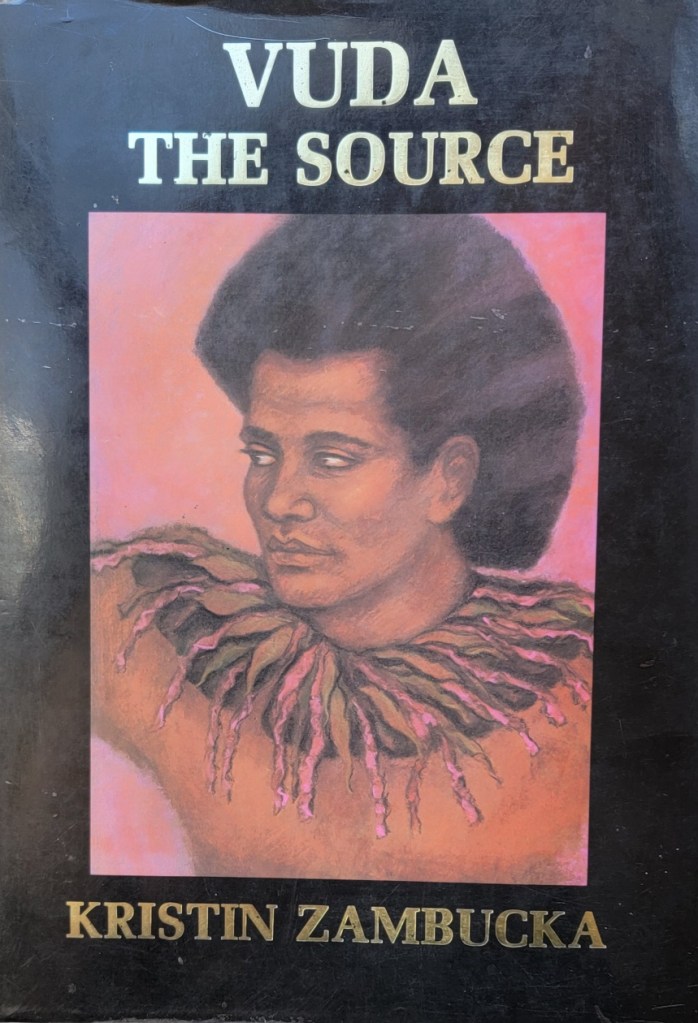
The legend refers to “the land of Tanganyika.” Lutunasobasoba according to the legend had an Egyptian wife, the Lady Nai. They travelled with their seven children in a small entourage of several families (implying several canoes), on a “double hulled canoe with sails… built in Isreal and sailed down the coast of Africa” according to the Chiefs. The vessel was called Kauniotini and renamed by Lutunasobasoba as Nakaunitoni. The seven children of Lutunasobasoba and Lady Nai are all named. “And the year that Lutunasobsoba and his followers landed in Fiji…was 18 BC” the Chiefs said, probably measured by generations. This story is told in incredible detail, but for our purpose here, I’ll leave it in summary form and provide some additional sources of information.
There are other records of Lutunasobasoba. In an interesting paper from 1895 that revealed Fijian cosmological workings and written by Sir Basil H Thomson, son of the Archbishop of York, states the following: “In a distant land to the far westward there were three chiefs: Lutunasobasoba, Degei, and Waicalanavanua. For some cause long since forgotten they resolved to leave this land with their wives and children, and they sent a messenger to the head craftsman, Rokola, bidding him build them a great canoe which they called the “Kaunitoni.” In her they set sail, and with them went a number of other canoes all seeking a new land. They found many lands, and at each some of the people stayed to make it their adopted home; but none of them pleased Lutunasobasoba.”
It is important that you are aware that there are some who contend that this story was created post Colonisation, while many Indigenous Fijians assert it is traditional. What became important to me was that there was corroborating evidence in other Polynesian cultures, with oral traditions in Aotearoa, and on Hawai’i also referring to an early connection with Egypt/Libya/North Africa. Following the thread of the early connection, there is some additional material worth looking at, from the sailing and navigation perspective.
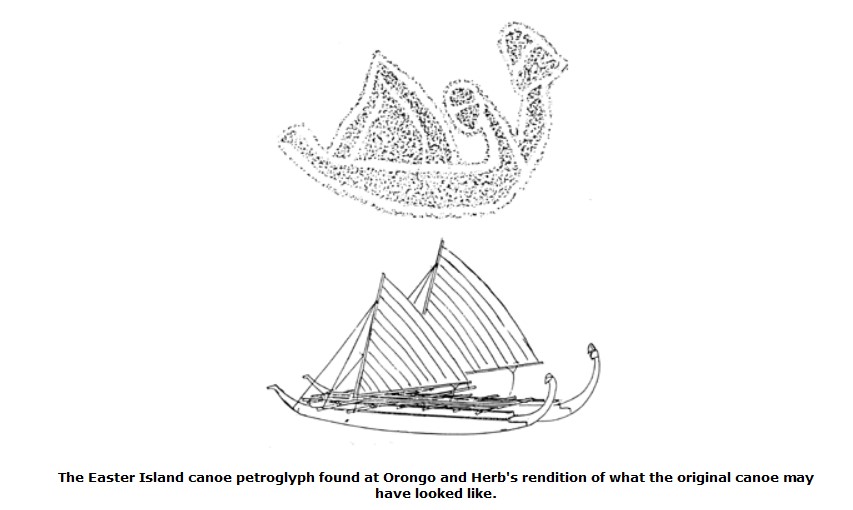
The image above comes from the archive of the Polynesian Voyaging Society (hokulea.com) based in Hawai’i. The link is worth a read, as it summarises the settlement of Te Moana Nui quite well in the starting paragraphs. The ‘Herb’ mentioned in the image caption is Herb Kawainui Kāne who researched traditional waka or va’a design, and built the Hokulea, the ship that would begin the revival of traditional navigation in Te Moana Nui a Kiva.
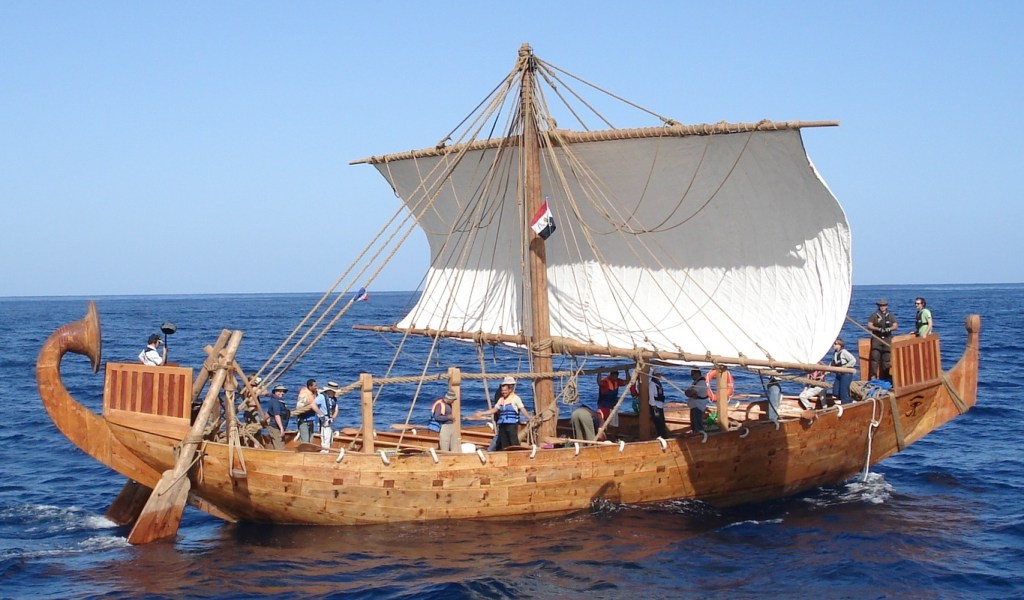
The image above is a reconstructed Egyptian vessel much older than the period we are looking at – 3,800 years old according to the University of Florida. However the visual similarity to the drawing by Kāne is thought provoking. The CABI Digital Library gives the commencement of the spice trade at 1000BCE, which involves trade between Indonesia, India and Egypt. This gives some idea of the area covered and the vessels used for the journey, all during or before 300 – 18 BCE. Sailing from Egypt to Indonesia is quite a feat.
What does this mean for the petroglyphs?
What I first wanted to do for you, was to outline what sailing conditions were like in the period of our interest, 300BCE – 100BCE. That Earth was a curved ball in space was known by some Moana navigators and some Egyptians, there are oral traditions of a connection, and the spice trade involved sailing from Egypt to Indonesia and back. It doesn’t take much to speculate further travel could have occurred.
In the next blog, we can start looking at the petroglyphs themselves. One thing I can say about them is that it is unlikely they were all done at the same time. It is quite typical of petroglyph sites to have some added to where previous ones were. Older glyphs on Hawai’i are linear, and at a later time, filled in petroglyphs were added. There are also petroglyphs of European sailing ships, clearly added in more recent times.
 The website of Mahutoa 'Pasha' Clothier