
The Moana and scientific notion that everything is interconnected is a major theme of my work
Working with ideas of Interconnection and whakapapa (genealogy) go way back to 1986, and continues up to the present. At the start it was quite consciously applied but now I have built intuition for the processes.
I would like to acknowledge my wider whanau (extended family including collaborators) and knowledge holders without whom I would not be me: Dr Te Huirangi Eruera Waikerepuru, Maata Wharehoka, Kawaihululani, the teachings of Kahu Abraham Kawai’i, and Tihoti.

There are limitless ways to think of interconnection.
Clothier understands that we are part of a complex and integrated whole; a mass or web of interacting details that forms a trio of humanity, nature and the universe – Victoria Andrews
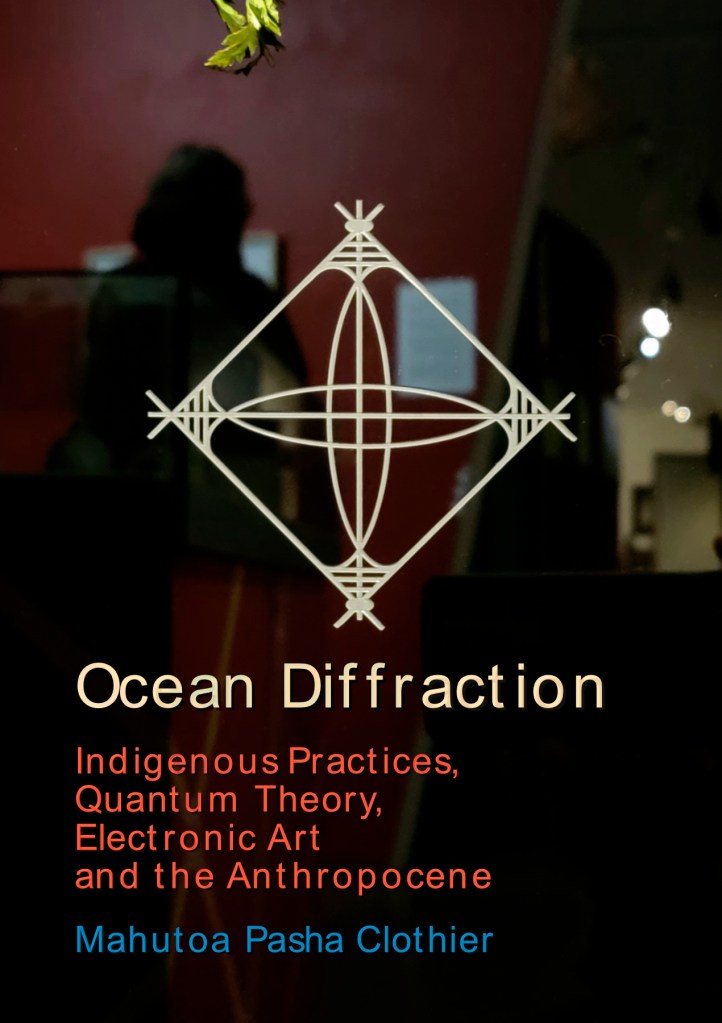
New book Ocean Diffraction
Pleased to announce Cambridge Scholars Publishing has published Ocean Diffraction: Indigenous Practices, Quantum Theory, Electronic Art and the Anthropocene.
Endorsements
“This is quality research that is compelling in its breadth and reach” – Professor Huhana Smith.
“The early narrative regarding Indigenous Practices is an excellent overview of a complex history, and therefore a contribution to knowledge… Clothier expertly draws on Indigenous practices and quantum theory via Barad, to form a diffractive methodology that affords bringing together and analysis of both fields of enquiry ” – Associate Professor Jane Grant.
“One of the most valuable pieces of research I have the pleasure of being involved with” – Dr James Charlton.
Set up by Cambridge academics, the publisher is not affiliated with Cambridge University or University of Cambridge Press. CSP has offices in Newcastle upon Tyne, Berlin and Barcelona.
Blurb
This book maps Indigenous awareness onto Western science to address today’s environmental and equality issues. A way forward is provided in Ngaru Whenua Ocean Diffraction, a decolonised framework uniting the Māori wave pattern for navigation with the science of diffraction.
This book is essential for those interested in Indigenous awareness and how this maps across to the world of Western science, in the context of the issues facing society today: the human relationship to the environment and ethnic equality. A way forward is provided based on Indigenous ecological connection as a significant counter to the Anthropocene. Traditional non-instrument navigators use a specific wave pattern to guide them to an island, called Ngaru Whenua by Māori. In Western science, the same wave pattern is called diffraction and applies to light, water and sound. For this meeting of belief systems to take place Clothier provides a decolonised framework called Ngaru Whenua Ocean Diffraction, an important step forward in the worldwide battle against colonial forces. Against this backdrop, a new suite of creative works is presented, forming evolved encapsulations of the trajectories discussed.
Te Wai o Te Taiao Flow Dissipation Theory
A key theory I’m collaborating on at present is Te Wai o Te Taiao Flow Dissipation Theory. This involves two separate components:
Part A. Te Kore, Te Pō, Te Ao Mārama
This is the semantic binding, which can answer questions beyond maths.
Part B. Four fundamental precepts (two limitations, two processes) from maths and science:
1. Gödel’s Incompleteness Theorem
2. The Planck length
3. Hubble Flow and Hubble Friction
4. The Second Law of Thermodynamics
These principles and their consequences are able to be solved by equations, in discreet components related to their discipline.
This link is to a brief summary with references.
Tangaroa Water Life
Tangaroa, translated by Dr Te Huirangi Eruera Waikerepuru as Water Life is an Atua or a God according to Maori and several Moana cultures. The audio begins with Tohora Humpbacks off the coast of Hawai’i recorded by Mark A MacDonald and no longer avaialble online. Then there is some sonified quantum experiments into the Higgs Boson from ATLAS, a particle detector at CERN. Plus there’s sounds made by the imagery itself, and vivo nose flute. All good to simply take the video in and absorb it, I’m just acknowledging the inspiration and audio sources.
Matariki [Pleiades, Subaru]
This video features an image of Matariki, which won second prize in an AUT Matariki competition a couple of years back. Matariki occurs at the Winter Solstice this year, and the soundtrack mixes audio from the Sun, audio made by the image itself (which is the weirdest sound), quantum particle decay and some vivo or nose flute. Thanks to CERN for the image of Pion decay that was sonified, and to Thomas Ashcraft for the sun audio.
Te Manu Ra’a o Ra’iātea
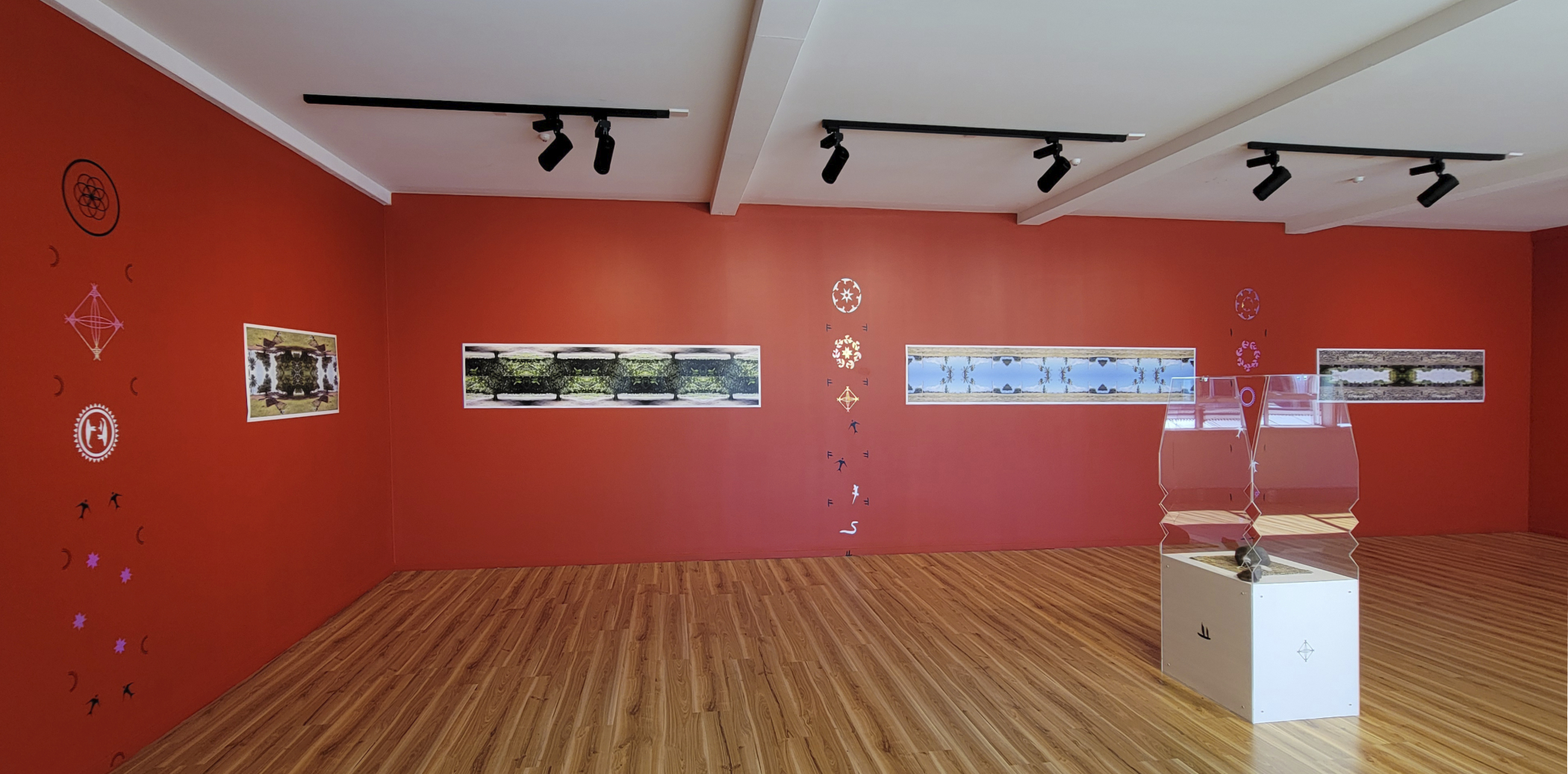
Presented in Fibre Gallery Ōtautahi Christchurch, featuring images of the sacred marae of Taputapuātea on Ra’iātea and the kōhatu (stone) brought back under the guidance of Tahu’a (Priest, Expert) Tihoti: Te Manu Ra’a o Ra’iātea. Te Manu Ra’a provides a context to open up to tapu and noa – sacred and mundane – to engage with tūpuna (ancestors) and host whakapapa workshops. The workshop was held at Tūranga Christchurch Public Library.
Kōhatu Ra’iātea

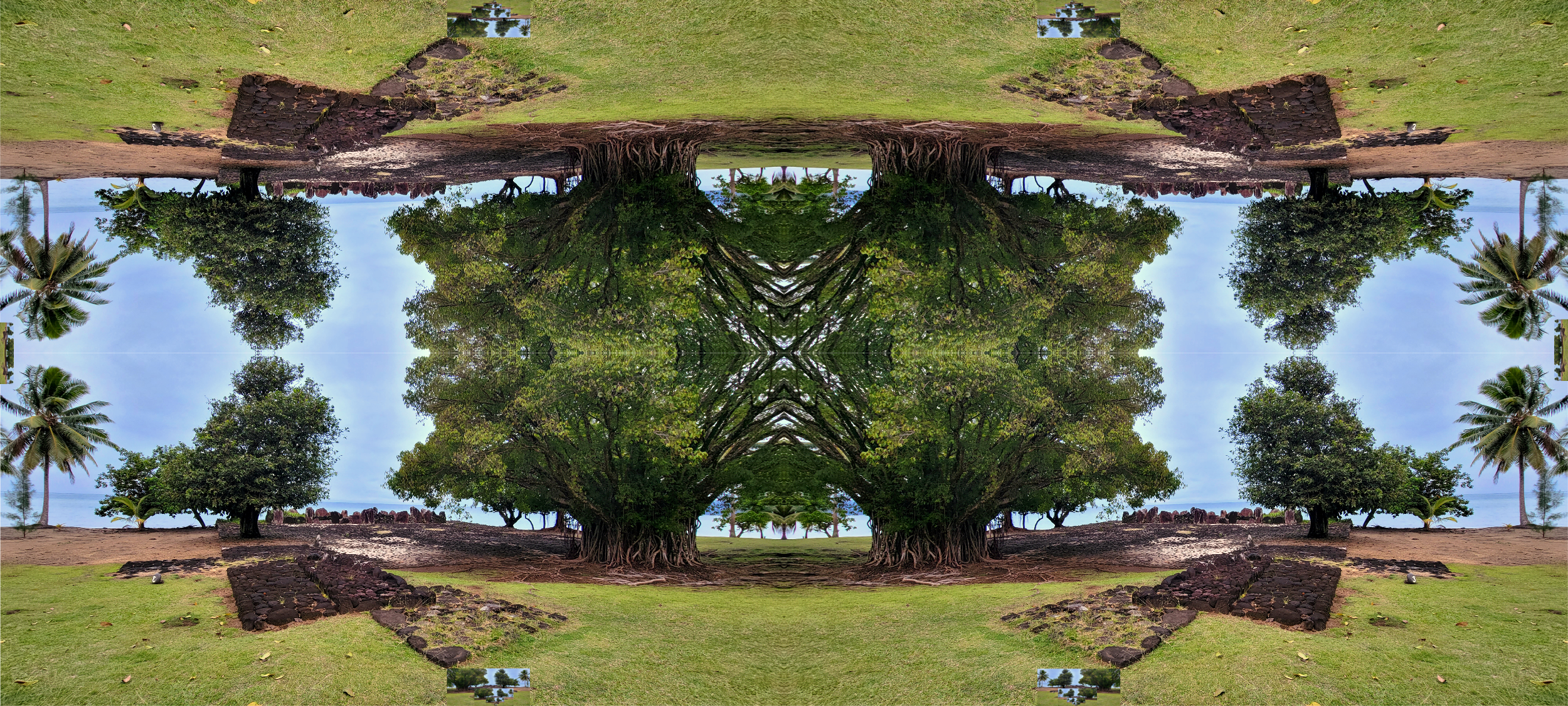

At top is the kōhatu placed on Taputapuātea under the guidance of Tihoti (it was bound by Kim Kahu). In the middle photograph is one of eight marae on the site: Hititai, the marae where rahui (restrictions on behaviour due to certain prior events) would be placed. Hititai is located adjacent to a Bunyan tree, which has special relevance to Moana peoples. The lower image shows the main marae at centre, above it is Hauviri (the marae for the investiture of the Tamatoa dynasty), and at top right on the edge of the sea is Opu-teina, the navigator marae. This link takes you to more on the project.
Interconnecting: pasha @ patea


This was a one person and whanau (extended family) exhibition at Aotea Untanganui Patea Museum in Taranaki Aotearoa New Zealand.
Included were images of tūpuna (ancestors) going back to the 1830’s, objects made today on Hitiaurevareva (Pitcairn), traditional Tahitian tattoo (the wahine or women of HMAV Bounty were Tahitian and from Huahine), geological specimens, artefacts from my parents such as their wedding photo and my father’s WWII Morse key, and references to connections to species – whales, plants and birds featured. There were rocks touched by fish, plants and humans. Truly an interconnected exhibition with whakapapa (genealogy) as a central organising theme. Further documentation can be found here.
Ngaru Whenua: Diffracting Indigenous Practices, Quantum Theory, Electronic Art and the Anthropocene

Doing a PhD was a major event in life and practice, and I’m very grateful to supervisors Amanda Yates, Kathy Waghorn, Janine Randerson and James Charlton. Ngaru Whenua are currents made downstream of an island, a texture which is known to Kaiwhakatere (navigators) and called diffraction in Western Science. Diffraction is key to the wave-particle duality of light which perplexed Quantum Theorists for most of the 20th century. Diffracting Electronic Art and the Anthropocene is necessary due to technology being implicit in the climate crisis. To bring knowledge bases into dialogue, it was necessary to propose a decolonised framework, which extended the notion of knowledge beyond that founded in Cartesian duality. Acknowledging precedence and interdisciplinary analysis were important. The Kōhatu Ra’iātea journey, the Interconnecting exhibition and a five-year commission for a Rainbow Bridge window at the Govett-Brewster Art Gallery, were all components of the PhD.
Te Niho o Te Atiawa Pou
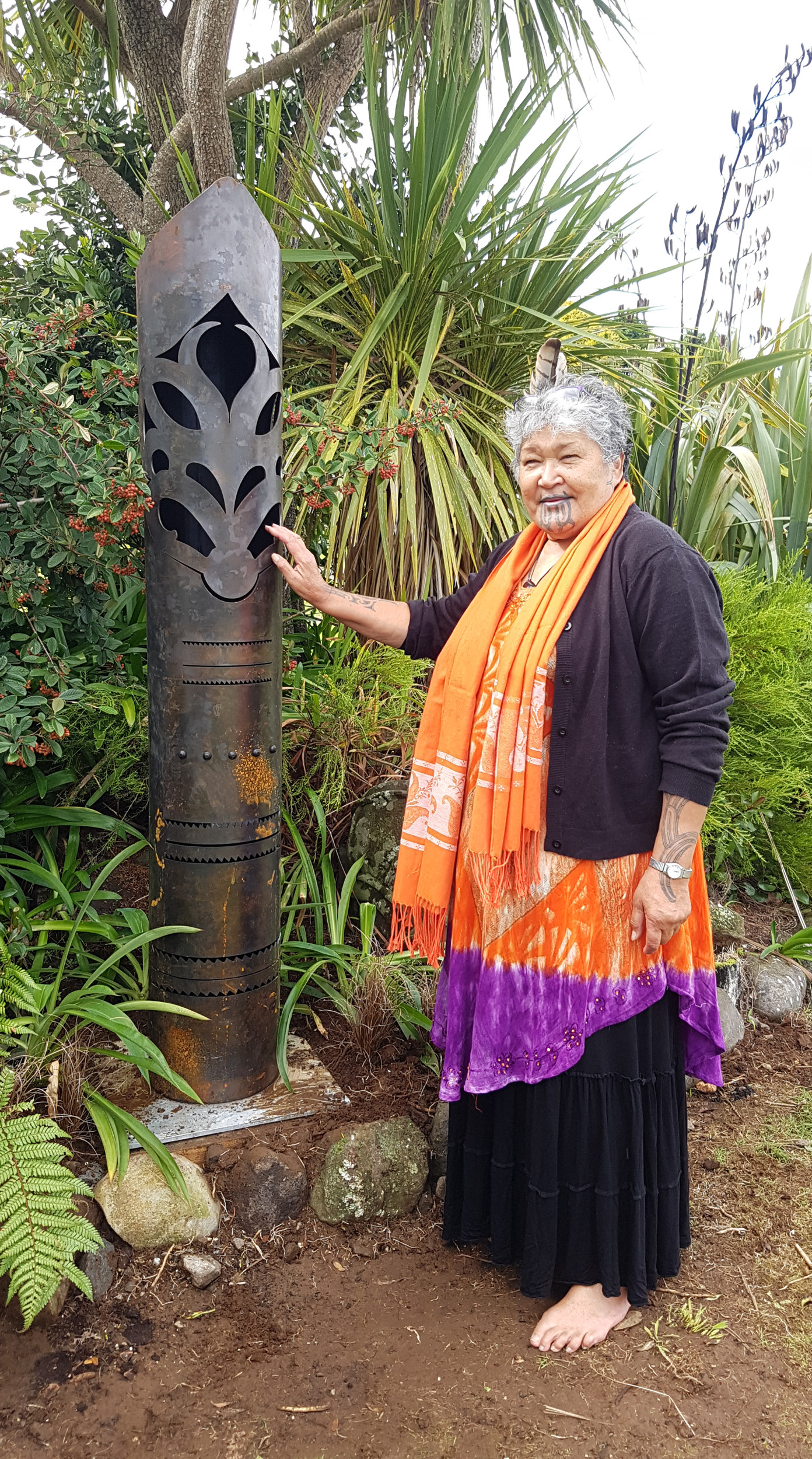
This work was a collaboration with Kaitiaki (Guardian) Maata Wharehoka (photographed above with the pou), B J Hetet and John Christini. When one of five buttons on the pou was pressed, kōrero (talk) by Maata spoke of the heritage of the Whare Nui (Meeting House) and her time as Kaitiaki. Using solar power was partly a response to Te Huirangi Waikerepuru talking of the energy of Rā, the sun, and also a response to Anthropocene issues. The Te Niho pou was a culmination of working alongside Māori, starting in 2006. I am extremely grateful for the lessons learnt and wisdom given.
Te Kore Rongo Hungaora
The Potential: The Group of People Who Seek Balance in Nature
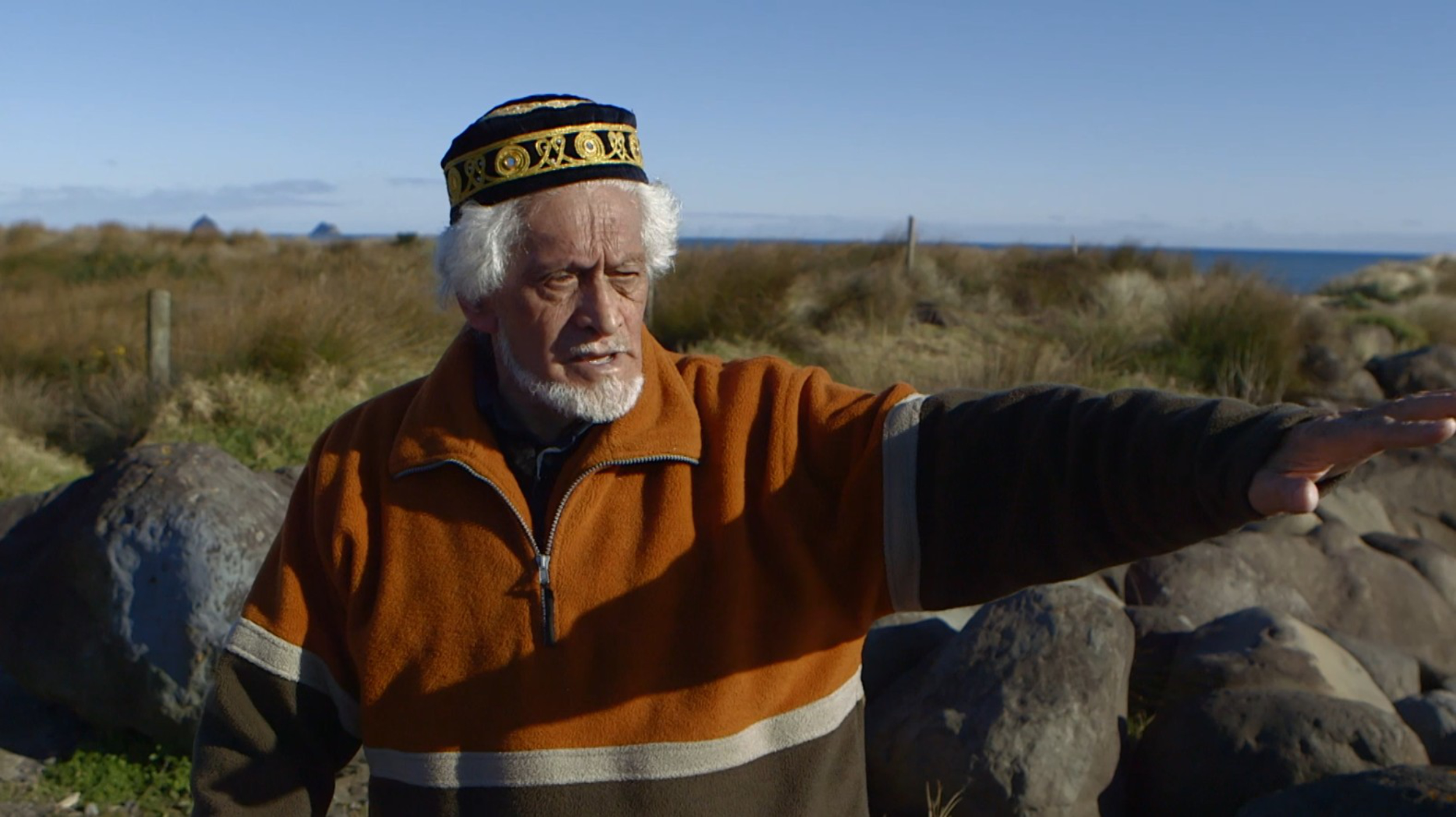
Presented in Cumhuriyet Gallery, Taksim Square, Istanbul at ISEA2011 and in documentary form in Rio de Janeiro a year later, Te Huirangi Waikerepuru (seen above in the Sharmila Samant video) provided a strong context for this project and many others over a ten year period. This project was significant in terms of complexity. ‘Life emerges from water’ is expressed in both Māori and Western Science contexts and many selected this theme for their work. Te Huirangi contributed Te Hihiri o Te Taiao Chart of Natural Universal Energies displayed 2.5metres wide on the wall, in an exhibtion including an Otago University computer model of a dogfish navigating and hunting using the electromagnetic field, by Mike Paulin, scenes from a Lisa Reihana Maui photo shoot, a whare (house) with river video from Sonja van Kerkhoff and Sen McGlinn, audio and street activities by Sophie Jerram and Dougal McKinnon, Harete Tito presented a painted kōhatu selected with protocols, Julian Priest’s project involved Whanganui river water, Rachael Rakena exhibited a video from Māori worldview ‘No man is an island’ and in Julian Oliver’s project microorganism behaviour could cause the computer browser to shut down.
Art-science: Light Seen and Unseen
This video is produced by collecting data images from science experiments – light from gamma rays (which cannot be seen), to infrared wavelengths, visible light, through to ultraviolet wavelengths. The images are then converted to sound and a sound track made, which I convert into animated video. This work was a finalist in the Lumen Awards of 2020, after being selected for exhibition in Gwangju Korea at ISEA 2019.
Bird Song Light Walk

This Festival of Lights commission was with long-term collaborator John Christini. It involved motion-activated units playing native birdsong accompanied by LED lights. Part of the aim was to return native bird song to urban locations. Six units were made and placed throughout a 120 metre walkway in Pukekura Park botanical garden. They were activated by a person walking under them.
Haiku Robots

This project utilised the idea of a small-scale integrated system, consisting of overlapping sub-systems, with a dynamic nonlinear data stream added – position data from two robotic cars avoiding an electronic fence and each other. It was an exploration of the idea that language might be an emergent property of systems rather than humans being an apex species. ‘cry owl so scare yeah,’ ‘red is my ace bird’ and ‘god hugs yes fern’ were sequential islands of near coherence. Commissioned by Puke Ariki, Andrew Hornblow and Julian Priest were collaborators and it could not have been done without them.
The Park Speaks
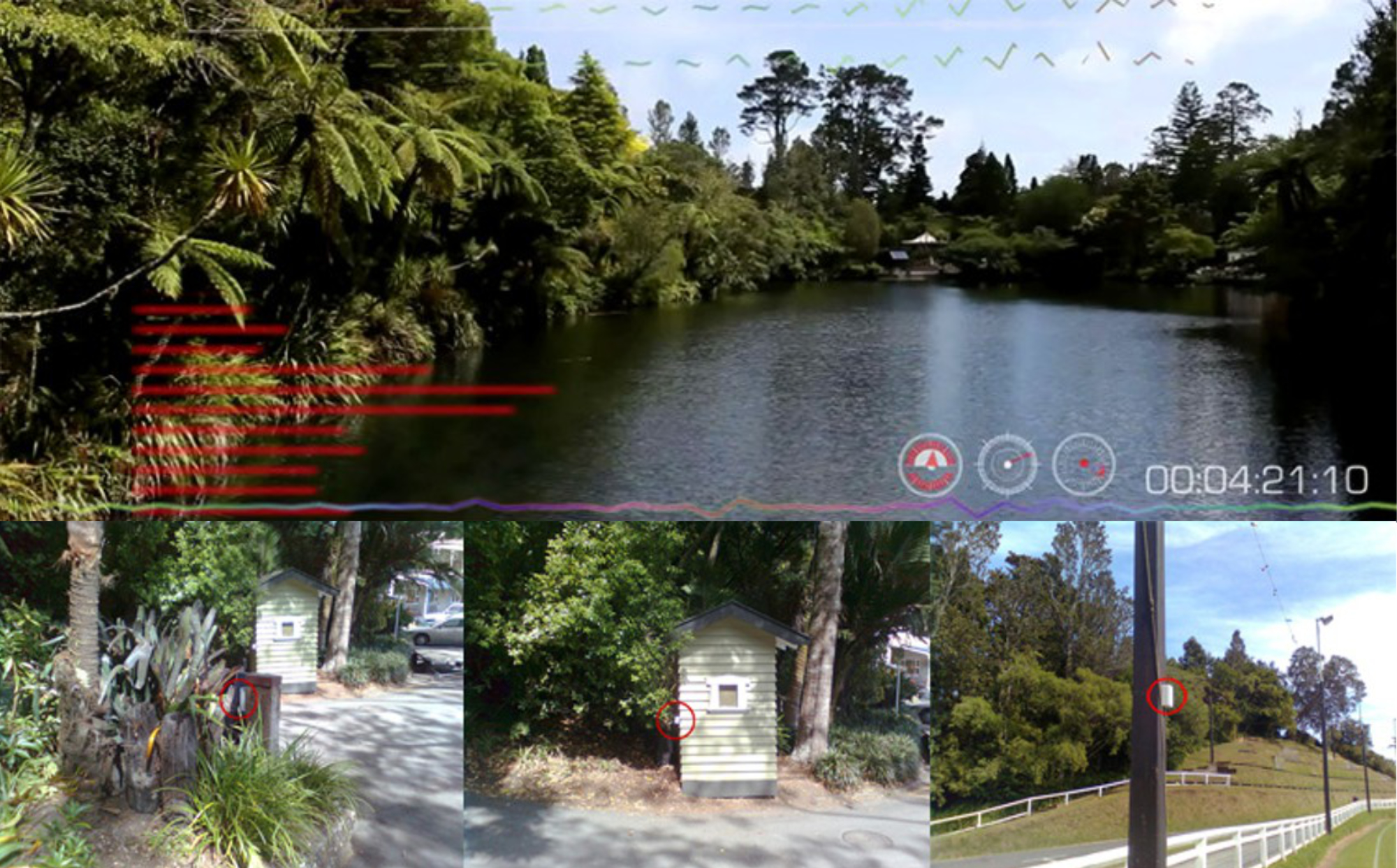
Some of my projects have been an exploration of the capacities of technology to provide meaningful experiences for the audience, in particular reframing our understanding of nature. The Park Speaks was a collaboration with Julian Priest, Andrew Hornblow and Adrian Soundy. Live environmental data – temperature, UV and people count (lower image) determined which of 140 audio files played in the installation, to accompany a dual desktop data projection in Puke Ariki (upper image – a 360° pan of the lake in Pukekura Park, lines and dials represent data orientated audio). This project also utilised the idea of a small-scale integrated system – interconnected. Commissioned by Puke Ariki, later iterations of the same system included an Indigenous cultural origin of the audio.

Wai
Wai was a response to emphasis placed on Wai (water or flow) by Te Huirangi Waikerepuru and was selected for exhibition at ISEA:Albuquerque. This was a curatorial project. Words spoken by Te Huirangi “Puwai Rangi Papa” emerge from the Taranaki whenua (land) in an animation by Australians Josephine Starrs and Leon Cemielewski above. Also included were Pou Hirihiri (Womb of the Universe) by Inahaa Te Urutahi Iwimaire-Waikerepuru, a video on water by Bombay-based Sharmila Samant, and Harete Tito, a small working model of ocean acidification by Julian Priest, a Geological and Nuclear Sciences video and data generated audio from a tree in Opunake, with audio by Darren Robert Terama Ward and Andrew Thomas, a local Navajo musician. Te Huirangi led us to engaging with local Indigenous when we exhibited internationally.

Te Takiwā o Leistavia The District of Leistavia
Te Takiwā o Leistavia (The District of Leistavia) is a hybrid artist micronation influenced by Hitiaurevareva and Estonia, a project selected for exhibition at the International Symposium on Electronic Art (ISEA) in 2004 in Tallinn and Helsinki. Kyllie Mariste was a local collaborator. Online and in-person forms collected voting preferences towards the Constitution of Leistavia: it became a Meritocracy with Ecologically Sustainable Values driving the economy, for example. District of Leistavia projects went on to be selected for exhibition at ISEA2006:San Jose and ISEA 2009:Belfast, interrogating our sense of cultural identity using online forms, and Making History again using online voting. This project also contains overlapping media that can be reformed in diverse, usual and unusual ways.
H C : N : CP Hybrid Cultures, Nonlinearity and Creative Practice
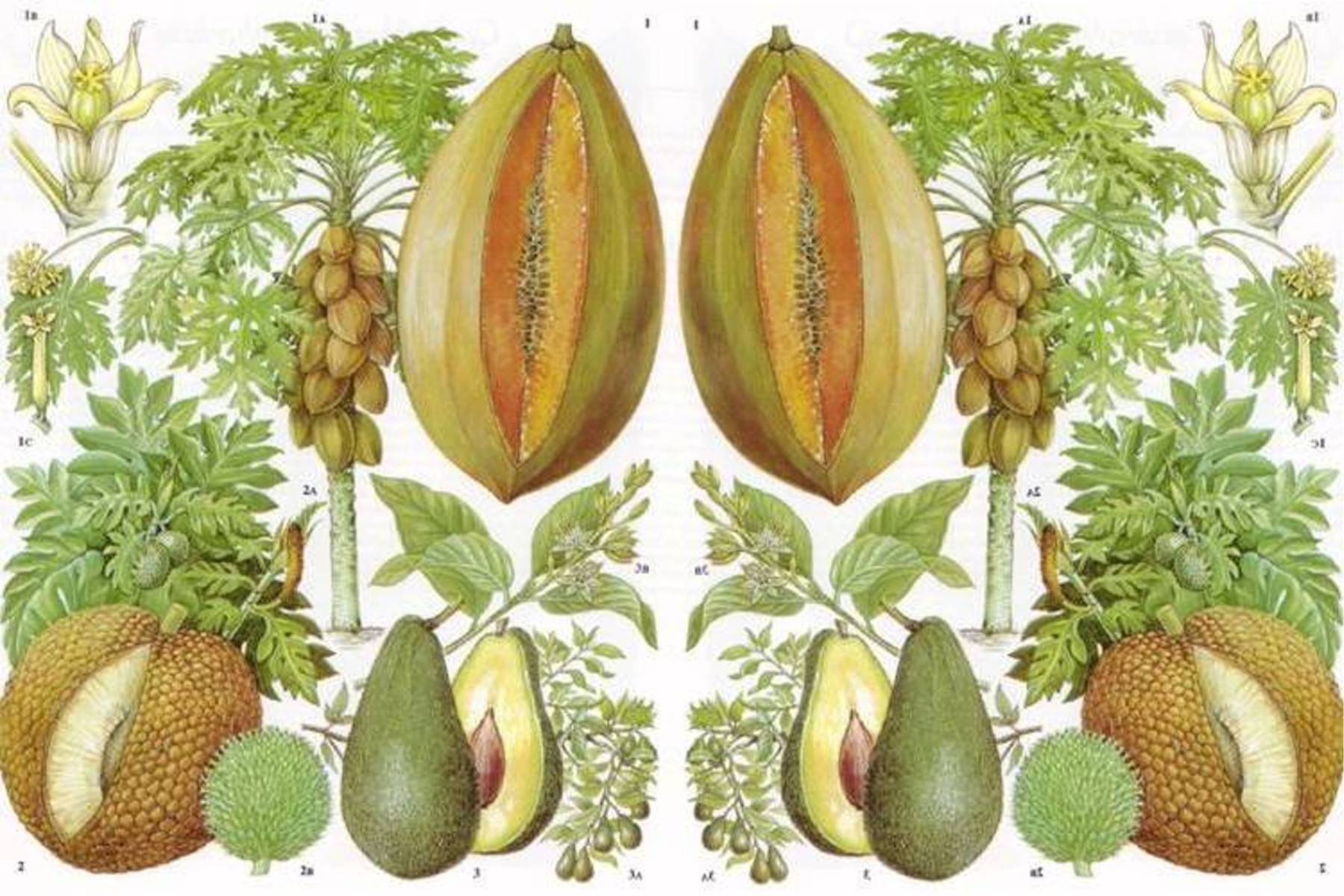
The images above and below are from my MA, completed in 2002. Ulu or breadfruit occupies a unique place in my whakapapa or genealogy. It had many uses on Tahiti, as food, for making surfboards, tapa, as a glue, waka (canoe) caulking, and as a decorative pattern. It was also used for trapping birds for their rare red and prized feathers. In 1788, commissioned by George III, HMAV Bounty left England and sailed to Tahiti to collect ulu seedlings to be taken to the West Indies for slaves to eat. The project failed twice – the first attempt led to the Mutiny on the Bounty, the second attempt resulted in slaves not eating the fruit. People from Tahiti, Huahine, Ra’iātea, and Tabooai along with the mutineers settled Hitiaurevareva (colonised as Pitcairn) in 1790.

The media structure of artworks
The image above goes to the core of natural, nonlinear systems, and linear presentations. It became a guide for a special sense of collage, in 4D spacetime. This was a foundation to projects going forward. On the left is a diagram of an exhibition of paintings in a gallery: one media. On the right is the media structure of my MA exhibition in 2002. You can see that multiple media are used that overlap in both usual and unusual ways. This overlapping is important – it allows for unique solutions, nonlinear relations and feedback loops.
 The website of Mahutoa 'Pasha' Clothier